
Before
- Nancy Antle
- Feb 26
- 17 min read
A short story by Nancy Antle

Before my parents got a divorce, there were family dinners every week after church.
One Sunday, when I was eight, I lingered at the dining room table savoring the last of my vanilla ice milk, swinging my legs, as jazz oozed from the radio. Sunshine filled the dining room, highlighting the dirty windows and the smoke that hovered in the air from Dad’s cigarette. The radio was turned low to allow conversation, but by then, there wasn’t any, especially since Harry now spent all his time with his girlfriend.
Mom cleared the table and Dad returned to his study, the clacking of typewriter keys the signal he wasn’t to be disturbed. He was working on his dissertation while looking for a job at another university. An hour later, I was coloring in the kitchen when Dad appeared holding a stack of envelopes and announced that he was walking to the mailbox. I begged to go with him, but he said no.
“Oh, take her with you,” Mom said.
Dad glared at her but said okay. I rushed to grab my coat from the peg by the door, shoving one arm into a sleeve, hurrying to prove I wouldn’t hold him up. Dad bent down to help me. I whipped around reaching for the other sleeve and hit the back of my hand against the cigarette dangling from his mouth. I yelped and Dad cursed, stomping on the smoldering cigarette. I licked my hand sucking in a sob. If I caused a ruckus, Dad wouldn’t take me. Mom fussed, wanting to put ointment and a Band-Aid on the burn.
“I hate Band-Aids,” I said. “And it doesn’t even hurt.” I knew Dad wouldn’t wait; he’d just go without me.
“Stay here. Mom will fix you up,” Dad said. “I’ll be back in a minute.”
I started crying then.
“For God’s sake,” Mom snapped. “Take her!”
Dad grabbed my uninjured hand and pulled me out the door and down the steps, his black overcoat unbuttoned and flapping in the fierce wind that bit my face. I trotted to keep up, swiping at my tears with my sleeve. My mittens had been left behind, but the wind cooled my burn as we hiked up the steep hill towards the blue mailbox, piles of dirty snow melting beside it.
“Can I put the letters in?” I asked.
“Yes!” Dad fired back meaning, don’t ask me anything else.
At first, I didn’t recognize the woman already at the mailbox. A gray hat was pulled down over her ears and her blue coat was buttoned at the neck. Strands of her long red hair danced around her collar, pushed back and forth by the wind, glinting in the sun.
When she turned and waved, it finally sunk in who she was.
“Miss Annie!” I shouted. I pulled away from Dad and ran to her.
My second-grade teacher bent down, smiling, holding out her gloved hand to shake mine like she did every day at school.
“My goodness,” she said, squeezing my bare hand. “Where are your mittens?”
“I forgot them,” I said. “But it’s okay. We don’t live far.”
Miss Annie stood and shook Dad’s hand then.
“Such a treat to see you both on the weekend.” Miss Annie didn’t seem concerned that Dad had nothing on his hands either.
“Nice to see you,” Dad said, smiling. Dad walked me to school every day on his way to his library cubicle, so he knew her too.
“Are you mailing letters?” I asked my teacher.
“I put them in the box right before you got here.”
Dad handed me his long white envelopes. I grabbed the handle on the little door, pulling it down and plopped the letters onto it, then let go. The door swung shut with a clang and the letters slid inside.
“Good job,” Miss Annie said. She leaned forward and put her hand on my shoulder. “It was lovely to see you. I’ll see you tomorrow at school.”
“Okay,” I said.
“And you too,” she said to Dad, putting her hand briefly on his arm before walking away, her head bent against the wind.
Back home, I told Mom that we’d seen Miss Annie at the mailbox.
“How nice for you,” Mom said, but she was looking at Dad when she said it.
In the warmth of the house, my burn throbbed again, and I asked Mom to put something on it, but she said Dad would have to help me.
For supper Mom made sandwiches with leftover pot roast, cooked carrots on the side. Dad complained that the bread was stale.
“It’s not my fault,” Mom said. “I only had enough for day-old bread.”
My parents stared at each other. I held my breath, waiting for the yelling. But Dad just looked at me and smiled.
“Maybe I can use it to make my famous French toast in the morning,” he said.
“Yum!” I said with relief.
After Dad went back to his study, I heard the back door close and looked out. Mom stood on our shoveled driveway, a bag of bread dangling from one hand. She stood very still for a moment then reached into the bag and pulled out a handful of bread. She shredded it into pieces, scattering them all around her. Feeding the birds, I thought. It wasn’t long before all she had left was an empty bag that she stuffed into the pocket of her apron..
Before my parents got a divorce and before I was burned by my father’s cigarette, there was the night we almost lost our friend, Harry, when I was seven.
Dad and Harry were both in the Ph.D. program and helped their professors grade exams and sometimes taught their classes. Harry lived in the basement apartment of our rental house. He was the only grown-up I was allowed to call by his first name. I especially liked the evenings when he’d walk up the stairs to our place to visit.
“For cocktails,” Mom said.
As long as I was good, I could stay in the living room with them, watching Mom or Harry mix drinks, reminding them to put a cherry in my ginger ale. Often Harry’d eat supper with us too, then do the dishes. He was used to being on KP, he told my mom. Dad explained that KP meant being on Kitchen Patrol in the Army.
“I learned lots about scrubbing pots!” Harry added, then laughed. “Lots and lots.”
Afterwards, he’d stay late into the evening talking with my parents, Dad mostly.
One night, more than a year before anything scary or sad happened, we were in the living room, just me and my parents. I was pretending to be asleep so I wouldn’t have to go up to bed.
“Harry drinks way too much if you ask me,” Mom said.
“I know.” Dad said. “But he saw horrible things at the end of the war. Worse than anything I saw. He says the alcohol helps, lets him forget and sleep.”
“The war ended years ago!”
Dad sighed. “Some things you never get over.”
“I don’t believe that,” Mom said.
“You weren’t there.”
The wood floor creaked as Mom went across it and up the stairs. I imagined her frown, her angry eyes. Dad’s heavier footsteps went into the kitchen, followed by the slap of the screen door as he went outside.
I didn’t understand about Harry. He always seemed fine to me. Whenever I saw him, he was smiling, often teasing me about the elephant or giraffe he saw on his walk home. He showed me magic tricks with coins or cards or told knock-knock jokes to make us all laugh.
To me he was the funny guy from our basement, even on the night he nearly died right in our living room.
Dad and I were taking down ornaments from our new fake Christmas tree, along with the few other decorations we had: a small wooden nativity scene from the mantle, an angel who sat on the bookshelf, the Santa and Mrs. Claus salt and pepper shakers from the dining room. He put them all on the end table. It was my job to wrap them in tissue paper and put them in the storage box. Mom was already in bed even though it wasn’t even my bedtime yet, a new habit of hers since the tragedy.
I heard Harry’s footsteps coming up the stairs, so I pulled open the basement door to let him in. He pushed past me, stumbling into our hallway just as Dad came from the living room. Harry looked at us with wild eyes, red faced, clutching his neck, making a sound that I’d only ever heard our cat, Clara, make when she was about to upchuck a hairball.
“What’s wrong?” Dad said, like Harry might be pulling our legs with a new joke.
But Harry couldn’t answer, except to make that cat-like breathy sound, part cough, part gagging, and point to his throat.
“Shit,” Dad said. He whacked Harry on the back, but it did no good, even though Dad had hit him hard enough to make Harry stumble into the living room.
Harry bent forward, his hands on his knees. Dad whacked his back again, looking into his friend’s face to see if there was any change. Harry’s lips were blue, and he wasn’t making the sound anymore. Dad then brought both fists down hard onto Harry’s bent over back, sending Harry slamming onto the floor with a thud that rattled the windows in their frames. Harry’s last ounce of breath whooshed out along with a big chunk of something pinkish and gray.
Dad knelt beside him. “You okay, buddy?”
I’d watched from a safe distance, terrified that we were going to lose Harry too. Slowly, he got to his hands and knees, turned over and sat with his legs splayed. He pulled a white handkerchief from his pocket and wiped his watering eyes, taking a deep breath, blowing his nose, honking, like Mom said was impolite. His shoulders started shaking and I thought he was crying, but when the handkerchief went back into his pocket, I saw he was laughing. Dad started laughing then too and sat down beside him, putting a hand on Harry’s shoulder.
“You scared the hell out of me,” Dad said. “I thought you were a goner.”
“Wouldn’t that have been the shit?” Harry said. “Survive the war then die from a damn piece of steak. And a piss poor excuse for a steak at that!”
I took a few steps closer to them and Harry reached out to take my hand. “I’m sorry I scared you sweetie,” he said. “I’m okay now.”
Dad went to the liquor cart and came back with two glasses. He handed one to Harry then sat on the edge of the sofa.
“Harry,” Dad said, rolling his glass between his palms. “I think it’s time you got yourself a wife.”
“Oh, yeah?”
“You need someone to look out for you, maybe cook you better dinners than shoe leather steaks.”
“Maybe you should put an ad in the personals for me: Babysitter needed for grown man who hasn’t learned to chew his food properly.”
“Come on, Harry,” Dad said. “You’re a catch. You’re smart, a nice guy.”
“You forget,” Harry said. “I don’t have a real job. Women tend to be put off by that.”
“At least go on a date with someone,” Dad said. “You’ll have a good job one day soon.”
“How about Miss Annie?” I said. “She’s nice and not married.”
Dad coughed, then took a sip of his drink. “That’s an idea.”
Harry grinned. “Truth is, I’ve been considering asking out the Dean’s secretary, Opal. She might be kind of sweet on me already.”
“Is she nice?” I asked. “And pretty like Miss Annie?”
“She’s both, kiddo,” Harry said. “You’d like her.”
“Maybe Opal would be Mom’s friend too,” I said.
“I bet she would,” Harry said.
“Mom doesn’t have many friends.”
“I’ll be sure to tell Opal that being friends with your mom is part of the deal if she goes out with me.”
Dad raised his glass. “To Opal, then.”
I went back to wrapping up the decorations on the end table.
“How is she?” Harry pointed one finger up towards my parents’ room.
“Either angry or sad all the time. Won’t talk to me.”
“Sounds kind of like shell shock. Like me.”
“Kind of but I can’t find a way to make it better.”
“Just give her more time,” Harry said.
Dad lowered his voice. “I’m trying but it’s hard to live with someone who hates you.”
I swallowed the knot in my throat while I wrapped the nativity scene – Mary, Joseph and baby Jesus in tissue paper and jammed it into the box.
Before my parents divorced, before I was burned by my dad’s cigarette and before Harry almost choked to death in our living room, there was a baby sister when I was six.
For two nights Harry stayed with me while Mom and Dad were at the hospital waiting for her to be born. Most kids I knew had grandmas that came to stay, but mine had both died years ago, so, it was up to Harry.
On the second morning, I found him sitting in the kitchen with a cup of coffee that smelled a lot like one of the drinks he had with my parents. He looked at me and pulled me onto his lap, wrapping me in his long arms, his big nose nudging the back of my head. He said he had something very sad to tell me. I feared Mom and Dad had been killed in a car accident like the parents of four siblings at my school, orphans now.
When Harry told me that Dorothy, my baby sister, had died as soon as she was born, I sobbed with relief that my parents were still here. Harry said it would be okay, that Dorothy lived in heaven now.
When I could speak again, I asked what day Mom was coming home, worried she’d miss Christmas.
“Friday or Saturday,” Harry said. “Your dad will be home tonight.” He took a gulp of his coffee. “This is a tragedy. We need to be extra nice to your parents.”
I whispered okay and Harry kissed the back of my head. I guessed that tragedy meant a big sadness but didn’t ask.
After I had my cereal and got dressed, I waited in the living room while Harry washed the dishes from the night before. Our Christmas tree that Dad bought from the Boy Scouts was decorated with glass ornaments that Mom and I had picked out at Woolworth’s. There was a special ornament with my name and one that just said, “Baby’s first Christmas.” My old bassinet, decorated with new fabric and bows rested under the tree, filled with wrapped presents that Mom told me were just things the baby needed anyway.
I’d been looking forward to helping Mom take care of the baby. Harry said Dorothy was in heaven now but who would take care of her? Maybe my grandmas would look after her? But how would they know who Dorothy was? My stomach hurt.
That evening, when Dad came home, we sat on the sofa together. He told me that Mom was resting and doing very well all things considered.
I asked Dad why our baby died.
“Dorothy had a hard time breathing.” He stopped and swallowed, then cleared his throat. “The doctor couldn’t save her.”
I started to ask more, but Dad said he had to go outside for a minute. I watched him walk down the hall to the back door and smelled the scent of a newly lit cigarette as the door clicked shut behind him.
Harry came from the kitchen. “C’mon, sweetie. Help me make supper.”
Since it was Harry doing the cooking, it wasn’t very complicated. I stood on a chair and turned the handle on the wall can opener after he got it started. When that was done, he removed the lid with the sharp edges so I wouldn’t get hurt. I dumped the big can of chicken noodle soup into a pot, then filled the can again with water and put that in too. Dinner in minutes, Harry liked to say, although he didn’t say it that night.
Mom came home at the end of the week, taking a long time to get out of the car, holding onto Dad’s arm. Harry opened the door and took Mom’s bag from Dad. When Mom was settled on the sofa, I ran to her. She hugged me then said she needed to lie down. She slipped off her shoes and curled up on the sofa facing the Christmas tree.
Dad and Harry had taken the baby things to the attic. I waited to see if she would notice all that was gone, but she just closed her eyes and fell asleep.
I went to school as usual then Dad or Harry, would bring me back in the afternoon. Mom was always still on the sofa. She had the TV on all the time and let me watch whatever was on, mostly game shows and cartoons. Dad and Harry fixed all the meals such as they were – eggs and toast, waffles, grilled cheese, and canned soup.
Just before Christmas, Dad brought me home from school. We found Mom sitting on the floor near the front door, mail scattered around her, her eyes red and watery. Dad pulled her up and hugged her. I put my hands behind my back and leaned into the wall, watching shyly, as if I shouldn’t be there. After a while they moved to the sofa in the living room and a crumpled piece of paper drifted to the floor from Mom’s hand.
I knelt and stacked up the mail, including the envelope Mom had torn open and the crumpled piece of paper, smoothing it out on top of the pile. I could read by then but some of the words were hard. The paper came from the “State of Ohio” where we lived. One of the words was “birth” and the one after it was “registration” – a word I remembered from when I started kindergarten. Dorothy’s name was in red type and so was her birthday. At the bottom it said, “Use for proof of age for school.” But Dorothy wouldn’t be going to school. I knew she had died. I just didn’t understand why the state of Ohio didn’t know that too.
I carried the pile of letters and bills into Dad’s study and set them next to his typewriter, feeling sad and confused. I didn’t want Mom to ever see that paper again, so I wadded it up with two hands and threw it and the envelope into the trashcan beside Dad’s desk.
That night after my bath, I crept into Dad’s study. I was worried I would be in trouble for throwing the birth paper away. I peered into the trash but inside was only the ripped envelope. The stack of mail was still beside the typewriter but now the cat paperweight was on top. Right underneath it, as if it had always been there, was the wrinkled piece of paper about Dorothy.
Before my parents got a divorce or I was burned by Dad’s cigarette, before Harry almost choked
to death in our living room or my baby sister died on the day she was born, there was a blue bicycle when I was five.
I had begged for a bike. Said I wanted it more than anything else. My new best friend, Sheri, had one, a shiny pink model with chrome that gleamed in the sun and long pink streamers hanging from the handlebars. She rode in circles on the driveway, the training wheels chirring when she tipped too far to one side. If only I could have a bike that beautiful.
Mom and I were reading on the porch the day that Dad brought home a bike he got at a yard sale.
Tears welled up as I looked at the mess. Nothing was right about the bike. Once spinach green, it was now peeling and faded, the tires flat. Mold dotted the white seat. The chrome was like sandpaper and rust covered the fenders. There weren’t any handlebar grips, just sharp edges at the end. Worst of all, no training wheels.
I gritted my teeth to keep from crying and went back to looking at the book on my lap.
“I wanted to check out the yard sales together, like we talked about,” Mom said. “We could have walked around to all of them before we decided.”
“I thought I should grab this one while I could,” Dad said. “It was cheap!”
“I should hope so,” Mom said.
I looked at the ugly bike again.
“I’ve got big plans for it,” Dad said. “I promise it will look better once I’m done.”
“What do you think?” Mom asked me. “Should we give Dad a chance to make it look nice?”
“But it doesn’t have training wheels,” I whined.
Mom put an arm around me. “Dad and I can be your training wheels, make sure you don’t fall.”
“People training wheels are the best kind,” Dad said, then winked.
“Okay,” I said. But what I really wanted to do was take that ugly bike to the dump.
While Dad drove to the hardware store for paint, Mom and I shared soda crackers and ginger ale at the kitchen table, food that mom said helped with the morning sickness she had because of the baby. She was sick most days, and not just in the mornings.
“Did I make you sick too?” I asked drawing pictures on the back of used typing paper.
“Yup,” Mom said. “But it went away after a few months. And you were worth it!”
She tickled my side, making me giggle, then handed me more soda crackers.
I tried to draw a picture of a bike like Sheri’s but the one I drew was more like the wreck we’d left in the front yard. I was sure Sheri would laugh if she saw it. Might even quit being my friend.
Outside our car sputtered to a stop in the driveway. I looked up as Dad came in the back door, holding a paper bag.
“Remind me what your favorite color is?” he said.
“Daaad!” Everyone knew my favorite color was blue, just like my new glasses.
Dad smacked his forehead. “Yikes!” He looked into the bag. “I don’t know what I’m going to do with this pink paint.”
“Take it back,” I demanded.
“Dad’s just teasing,” Mom said. “Again.”
Dad handed me a small can of paint with a blue spot on the lid. “Is this the right color?”
I nodded.
“Good! I’m going to start sanding.”
“I’ll come out soon,” Mom said.
For the rest of the day, I played in the driveway, hopscotch mostly, trying not to look too often at Mom and Dad working. I hoped that a miracle might really happen, and I would have a beautiful bike when they finished.
Our new friend, Harry, came out of his apartment to talk to my parents then wandered over to me, watching me hop. I didn’t know him very well yet, so I felt shy.
He took a turn hopping, his arms spinning like jerky windmills, making me laugh, then said his dissertation was calling to him.
“It’s telling me to get back to work!”
“You’re silly,” I said.
“Am I?” He acted surprised.
“Yes!”
“In that case, Mr. Silly will see you again soon.”
I giggled as he hopped over to the side door and went inside.
Not long after that, there was thunder in the distance, Dad stopped painting, and Mom wheeled the bike into the garage. The roof was in good shape, but the whole garage leaned to the right. My parents never parked the car inside so there was plenty of room for them to keep working. I went inside to watch TV.
In the morning, Dad made French toast for breakfast. I had it with lots of butter and syrup. Mom had soda crackers and ginger ale again.
“Can I ride the bike today?” I asked.
“Soon,” Dad said. “I have to go back to the store.”
“Why?” I asked.
“I just need a few things.”
Dad started singing This Old Man as he headed out to the car.
“What things?” I asked Mom.
She smiled and shrugged like she didn’t know but I was sure she did.
Later, when Dad finally hollered for me to come outside, I jumped up and dashed to the door.
“Wait!” Mom said. “I have to take pictures. This is an important day.”
She went out ahead of me, carrying a box camera. Her dad had sent it to her so she could send him pictures.
“Hold still,” she said. “And give me your best smile for Grandpa.”
I did, then ran down the three steps to the driveway and the bike, Dad standing beside it. The bike looked better. The tires were pumped up and patched. The chrome had been made smooth, touched up with silver paint that didn’t match. The fenders were blue, and the old seat was bleached cleaned. The new white pedals and grips with blue and white streamers from the hardware store went a long way towards making it beautiful.
And there was a bell.
A shiny new chrome one attached to the handlebars that I could ring with my left thumb. I tried it, and the TRING was almost as loud as our telephone.
“That bike is the Cat’s Pajamas,” Harry said coming outside.
I giggled. “What does that mean?”
“It means your bike is spiffy,” he said. “Like the bee’s knees!”
I giggled again.
“Ready to try it?” Dad asked.
I looked at Mom.
“This training wheel is ready,” she said. “What about you, Dad?”
“Ready!”
Mom handed Harry the camera. “You’re the new photographer.”
“Yes, Ma’am.” He saluted her then held the camera up to his eye and snapped a photo of us next to the bike.
I put the kickstand up then straddled the bike. Dad put one hand on the seat, the other on the handlebar. Mom held the handlebar on the other side. Slowly, I pushed myself up onto the seat, my feet on the pedals. Butterflies flapped in my stomach.
“Let’s go!” Dad said.
We went up and down the driveway, six times, careful not to bump our car.
“Good job!” Mom said. When we got to the end of the driveway,” she said, “Turn and go down the sidewalk this time.”
I steered to the left, wobbling a bit and pedaled down a long stretch of concrete going a little faster, Mom and Dad ran alongside me, huffing and sweating but smiling. I was sure they would both be there with me until I learned to ride all on my own.
Nancy Antle wrote for children and young adults for decades and was published in the U.S., Australia and China. She’s now returned to her first love, writing short stories for an older audience. She curates a website on Medium dedicated to the writing of Afghans living all over the world. Learn more at nancyantle.com
Images:
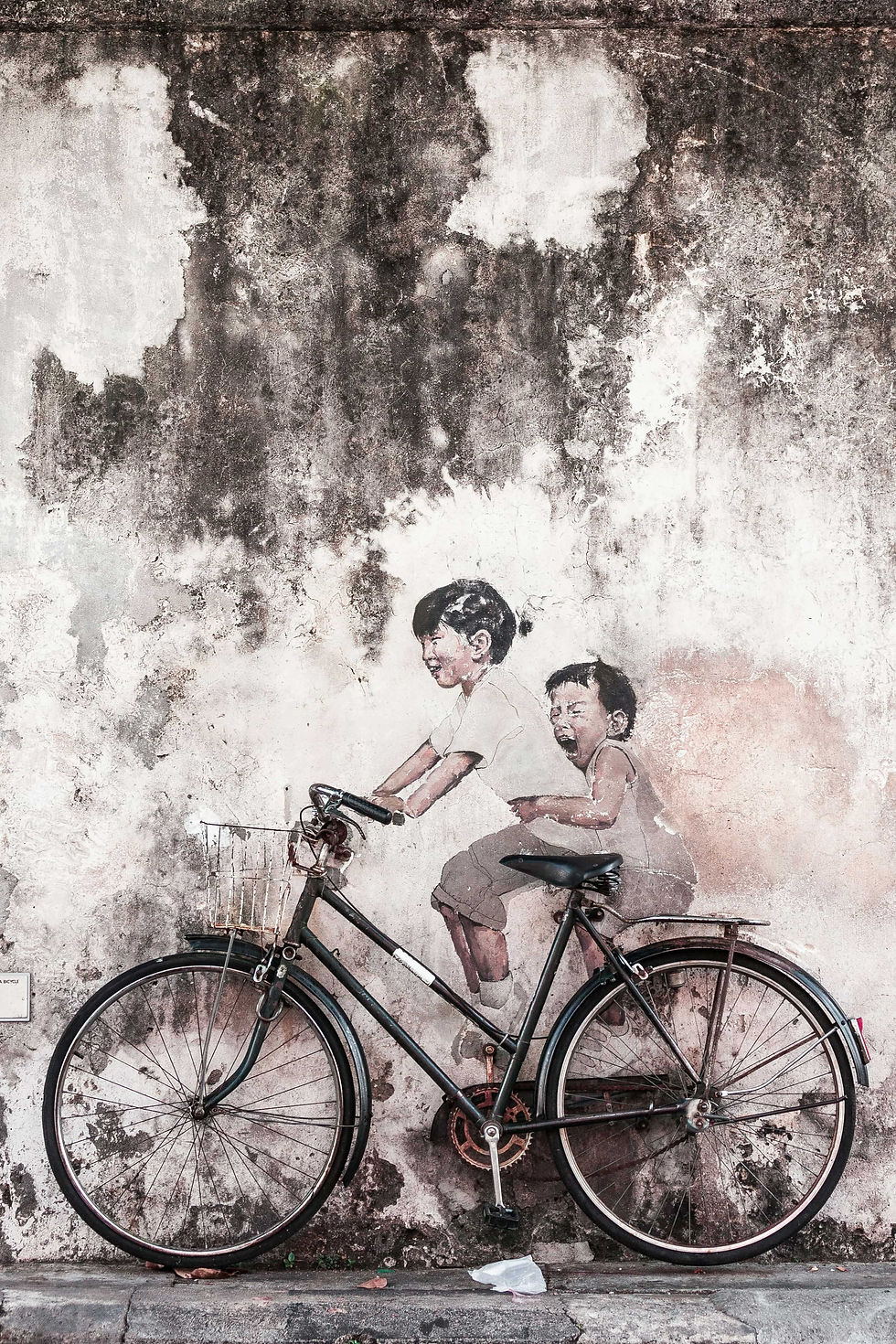
Bicycle built for two by Beng Ragon
Ghost bike by Yaopey Yong


A most delightful bittersweet story.