
When the Mountain Falls, Run Toward It

Updated: Aug 31
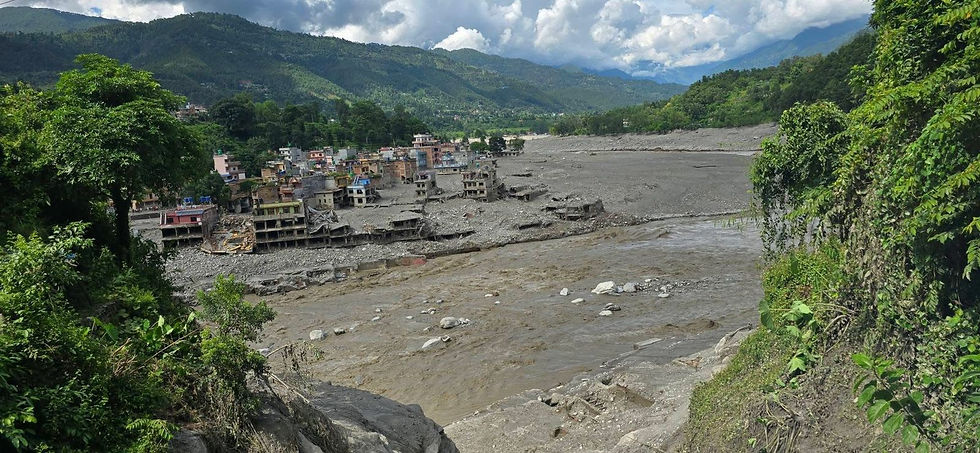
A glacier detaches from its mountain base and careens downhill, sucking in rocks, mud, trees, bridges, houses, animals, cars and people. Everything in its path, destroyed.
You saw it, too, right?
Hard to fathom the speed, the force, the unequivocal finality of the flooding in Nepal and Tibet. Simply horrific.
Many people reached out to me to express concern. Since I travelled in Nepal last April, they asked if the flood happened in the same area – Tsum Valley. (It did not.) Were people I knew ok?
A simple yes or no won’t answer this one. The people I know are all ok. Thank goodness. But Dhawa Lama, our lead guide, told me that four guides he knows from Tsum were killed in the flood. These young men leave behind wives and children in remote villages. The wives tend livestock, work their small farms, and look after the kids. Now they face a future without their husbands, and without their families’ main source of income. They must start all over again, from scratch.
As of this writing, over 700 people are confirmed dead and more than 3000 are still missing. So imagine those same four families, multiplied. The math of this tragedy is just starting to compound.
Of course, it's not just human life that's been lost. Animals are gone, too. Wild animals, like the Himalayan tahr I saw on the hillside, and the snow leopards the monks at Mu Monastery described to me. Pets, too. And farm animals, who are integral to rural life in Nepal, as I witnessed firsthand. Teams of yak yoked to a plow to plant a field. A woman herding her goats up a hill. The stout donkeys that accompanied us up the trail. Nepal is still a pastoralist country, so each animal killed is a double whammy. A loss of both life and livelihood.
During that April trip, our teacher, Geshe Tenzin Zopa, spoke about compassion, the heart of Buddhist practice. One thing he said keeps coming back to me now. Most people run away when they see suffering. As if they’ll catch it, like a cold. But the compassionate person does the exact opposite. They run headlong, straight at it.
Cuckoo, right? No, not really. Because compassion knows this truth: those kids who just lost their dads, those are our kids. And the women left to forge a new reality? They’re our daughters, our nieces and granddaughters. Ourselves. Of course we run toward them.
When I wrote in the Certain Age Manifesto that we are a force, this is what I meant.
Another line from the Manifesto applies here too: We enjoy what we’ve earned and share what we have – thereby making miracles.
If you are so moved, here are four organizations with active flood relief programs. While there are many large charities that are no doubt doing great work in Nepal, I focused on smaller organizations either based there or with a long history in the country. These groups have a track record that can be checked, and address a range of issues, so that you can contribute in the most meaningful way for you.
Giving even a little bit will go a long, long way. So let’s make some miracles today.
Direct Relief: Medical care and supplies
FPMT: Humanitarian relief through an established Buddhist community network.
Nepal Youth Foundation: Providing support for children, including emergency shelter, education and food.
Sneha’s Care: Animal rescue and veterinary care, including community and farm animals. (The International Fund for Animal Welfare (IFAW)’s local flood response partner).
Note: I also looked for a credible way to direct donations specifically to affected communities in Tibet, but so far I haven’t been able to verify one.
Jean Shields Fleming is founder and editor-in-chief of Certain Age. She is the author of the novel Air Burial. Read an excerpt from her new book, All the Reasons Why.
Images:
Cover image of flood damage courtesy of Dhawa Lama
Other images by the author

Comments